
Research article / Open Access
DOI: 10.31488/HEPH.197
Development Of A Web-Based Health Literacy Promotion Model For Anemia Prevention Among Public Health and Allied Health Sciences Students: A Paor-Based Study
Wannisa Raksamat 1, Wichaporn Intharachuti 2*, Srijan Pupjain3, Sappaporn Wirattanapokin4, Kaewjai Maleelai5
1. Kanchanabhishek Institute of Medical and Public Health Technology, Faculty of Public Health and Allied Health Sciences, Praboromarajchanok Institute, Nonthaburi, Thailand.
2. Sirindhorn College of Public Health, Yala, Faculty of Public Health and Allied Health Sciences, Praboromarajchanok Institute, Yala Province, Thailand.
3. Boromarajonani College of Nursing Nakorn Lampang, Faculty of Nursing, Praboromarajchanok Institute, Thailand.
4. Kanchanabhishek Institute of Medical and Public Health Technology, Faculty of Public Health and Allied Health Sciences, Praboromarajchanok Institute, Nonthaburi, Thailand.
5. Sirindhorn College of Public Health, Ubon Ratchathani, Faculty of Public Health and Allied Health Sciences, Praboromarajchanok Institute, Ubon Ratchathani Province, Thailand.
*Corresponding author: Wannisa Raksamat . Kanchanabhishek Institute of Medical and Public Health Technology, Faculty of Public Health and Allied Health Sciences, Praboromarajchanok Institute, Nonthaburi, Thailand, 11150. Email: wannisar@kmpht.ac.th.
Abstract
This study aimed to develop and refine a web-based health literacy promotion model for anemia prevention among public health and allied health sciences students using a Planning – Action – Observation - Reflection (PAOR) framework. This Phase 2 developmental study integrated a preceding situational assessment, student focus groups, and a six-domain health literacy framework during Planning. Action produced a five-step web-based Prototype V1. Observation comprised sequential evaluation by three experts and a try-out with 30 students using quantitative ratings and open-ended reflections. Reflection integrated expert and student evidence through Retain-Modify-Add-Remove decisions to produce Prototype V2. Of 39 expert item-level judgments, 30 (76.9%) were very good, 8 (20.5%) pass, and 1 (2.6%) needs improvement. Font presentation and AI voice clarity were modified before the student try-out; smartphone-responsive redesign was deferred. Student evaluation was very high overall (M=4.68, SD=0.23), with perceived usefulness highest (M=4.78, SD=0.27). Reflections supported multimodal and interactive learning but identified content complexity, technical issues, and time constraints. Correct-answer feedback was subsequently added to quizzes. The PAOR-based process produced an evidence-informed Prototype V2. Findings support systematic development and preliminary user evaluation, not intervention effectiveness; subsequent outcome and device-specific usability evaluation is required.
Keywords: Anemia; Health Literacy; Health Promotion; Internet-Based Intervention; Artificial Intelligence; Students
Introduction
Anemia remains a major global public health problem and contributes substantially to morbidity and disability [1,2]. Iron deficiency is an important contributor, although anemia has nutritional, physiological, infectious, and other causes [3]. Progress in reducing anemia remains insufficient in many settings, supporting continued attention to prevention and nutrition-related health promotion.
University students are an important but comparatively less targeted population for anemia prevention. Studies have reported anemia among undergraduates, including health sciences students [4-9], with female students particularly vulnerable because of menstrual blood loss, dietary factors, and lifestyle patterns [10, 11]. Anemia may be associated with fatigue, reduced physical capacity, impaired cognitive performance, and poorer well-being [12, 13]. These concerns are relevant to public health and allied health sciences students, who also require skills to communicate health information in future professional roles.
Studies have documented gaps in anemia-related knowledge and preventive practices among university students, including health-related disciplines [14-19]. Anemia prevention, however, requires more than factual knowledge: students must identify reliable information, interpret and communicate it, appraise competing claims, make informed decisions, and apply information to self-care. Health literacy has been defined in terms of the knowledge and competencies needed to access, understand, appraise, and use health information and services [20].
Drawing particularly on the six-domain Thai health literacy framework and related health literacy pathway and media-literacy concepts [21-23], this study operationalized health literacy as access to health information and services, knowledge and understanding, communication, self-management, media literacy, and decision-making.
Digital learning environments can support these competencies because university students routinely encounter health information through websites, social media, and online search. A systematic review found that university digital-health-literacy research remains predominantly descriptive and identified a literacy-to-intervention gap [24]. Another review found a limited higher-education intervention evidence base and emphasized interactive components and clearer theory-informed design [25]. Web-based health education should therefore engage students in finding, understanding, appraising, communicating, and applying information rather than merely presenting content.
Generative artificial intelligence (AI) adds both opportunity and risk. It provides conversational access to health information, yet generated content may be inaccurate or misleading. Evidence indicates that generative AI can increase the volume, speed, and perceived credibility of health misinformation [26]. Educational use should therefore include explicit questioning, verification, and critical appraisal. In this intervention, AI was used as a learning scaffold rather than a diagnostic or medical decision-making tool.
Despite evidence on anemia prevalence, associated factors, knowledge, and practices among university students [4-19], less attention has been given to systematic development of comprehensive anemia-prevention health literacy interventions. Broader university health literacy research also provides limited detail on how theory, user needs, educational activities, expert input, and user experience are translated into components and refined before effectiveness testing [24, 25].
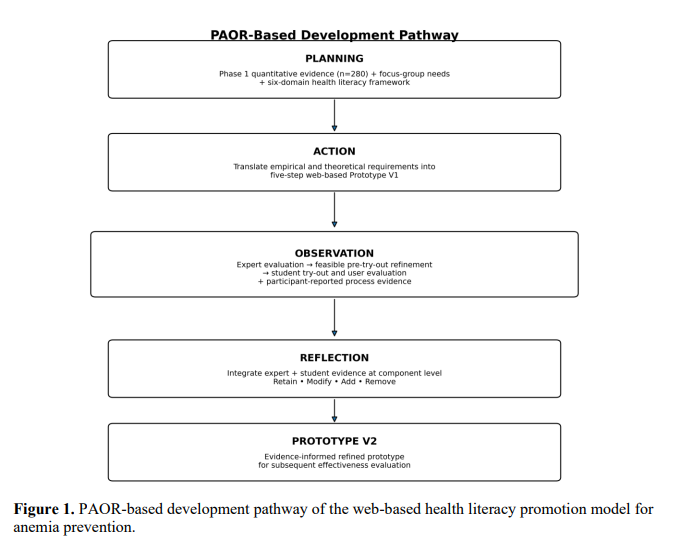
The present study used a Planning-Action-Observation-Reflection (PAOR) framework [27]. Planning integrated a preceding situational assessment, student focus-group needs, and the six-domain health literacy framework; Action produced Prototype V1; Observation generated formative evidence through sequential expert and student evaluation; and Reflection integrated that evidence into Retain, Modify, Add, or Remove decisions to produce Prototype V2.
This study aimed to develop and refine a web-based health literacy promotion model for anemia prevention among public health and allied health sciences students. Objectives were to (1) translate empirical needs and six health literacy domains into intervention components; (2) examine preliminary appropriateness, comprehensibility, usability, acceptability, and perceived usefulness; and (3) integrate evaluation and process-related evidence through structured reflection to produce a refined prototype.
Materials and Methods
study design
This developmental study constituted Phase 2 of a broader research program on health literacy promotion for anemia prevention among public health and allied health sciences students. The present phase focused on systematic development, preliminary evaluation, and refinement of a web-based health literacy promotion model rather than testing its effectiveness.
Development followed the PAOR framework as presented in Figure 1 [27]. Planning integrated Phase 1 findings, focus-group needs, and the six-domain health literacy framework; Action translated these requirements into Prototype V1; Observation comprised sequential expert and student formative evaluation; and Reflection integrated evidence at component level to determine Retain, Modify, Add, or Remove decisions and produce Prototype V2.
Study Setting and Participants
The developmental phase reported in this study was conducted from March to June 2026 at the Kanchanabhishek Institute of Medical and Public Health Technology, Faculty of Public Health and Allied Health Sciences, Praboromarajchanok Institute, Thailand. Participants included students contributing to the needs assessment, three experts evaluating Prototype V1, and 30 students participating in the prototype try-out.
For Planning, a focus group discussion was conducted with 12 first-year students purposively selected based on the CBC-based health examination classifications recorded in Phase 1. Participants represented three anemia-related health-status groups: normal (n=4), at risk (n=4), and having anemia (n=4). For expert evaluation, three experts were purposively selected based on their relevant expertise in hematologic disease, information technology, and educational technology, respectively. For the user try-out, 30 first-year students were purposively selected using the same Phase 1 CBC-based health examination classifications: normal (n=10), at risk (n=10), and having anemia (n=10). None of the try-out participants had participated in the preceding focus group discussion.
Planning: Identification of Needs and Design Requirements
Planning integrated Phase 1 findings, student focus groups, and the six-domain health literacy framework. Phase 1 included a multi-college situational assessment and CBC-based health-examination data from the prototype college. Complete situational-assessment data were available for 280 first-year students from seven colleges (302 targeted), recruited through college-based quotas with volunteer participation; 226 first-year students at the prototype college had complete CBC-based health-examination records supporting anemia-related status classification. In the 280-student dataset, overall anemia-related knowledge was moderate (mean percentage score=72.64, SD=18.24). Mean frequency-based health literacy scores were 3.66 (SD=0.86) for access, 3.29 (SD=1.05) for communication, 3.73 (SD=0.82) for self-management, 3.84 (SD=0.87) for media literacy, and 3.87 (SD=0.86) for decision-making. Focus groups explored anemia understanding, information seeking and credibility appraisal, desired content, preferred media and activities, and expectations for web-based learning. Findings were mapped to directly supported health literacy domains; domains not prominent in focus groups were retained when supported by Phase 1 evidence or theory.
Students showed variable basic understanding of anemia, commonly associating it with pallor and fatigue, while interpretation of technical information such as anemia-related blood results was less clear. Family members and social media were common information sources. Systematic information seeking and explicit credibility checking were limited. Desired content included anemia basics, causes and risk factors, symptoms, prevention, practical diet, appropriate medication or iron-supplement information, self-care, health-service seeking, follow-up blood testing, and basic understanding of relevant blood results. Students preferred concise, multimodal, interactive, flexible, self-paced learning with simple navigation.
The completed focus-group analysis generated five interrelated empirical themes: (1) Limited and Uneven Anemia Understanding; (2) Unsystematic Information Seeking and Limited Credibility Appraisal; (3) Need for Practical and Self-Care-Oriented Information; (4) Preference for Concise, Multimodal, and Interactive Learning; and (5) Need for Flexible, Self-Directed, and Simple Web-Based Learning. These themes were considered together with the Phase 1 quantitative findings and the six-domain health literacy framework when defining design requirements for Prototype V1.
Action: Development of Prototype V1
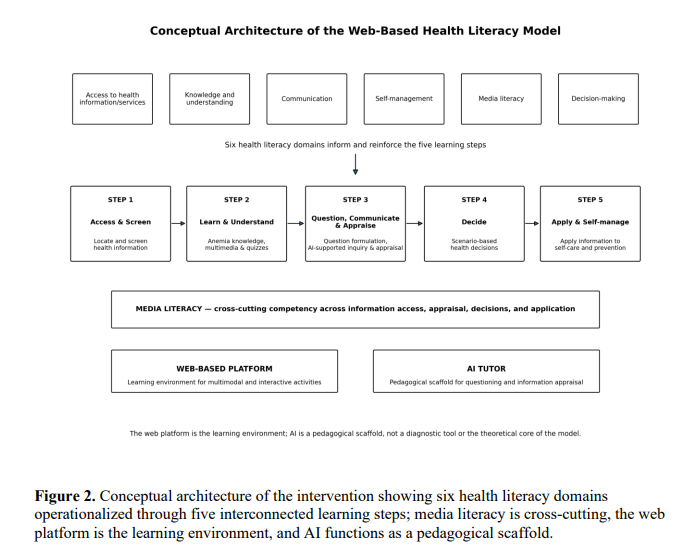
Prototype V1 was organized into five sequential learning steps that translated the six health literacy domains into web-based activities. Each step emphasized a primary competency while reinforcing related domains; media literacy was treated as cross-cutting.
Step 1, Accessing and screening information, introduced recommended sources, structured searching, and basic source screening.
Step 2, Understanding anemia, provided six concise learning modules with multimedia and short quizzes covering anemia-related knowledge relevant to prevention and self-care.
Step 3, Asking and communicating, used structured question formulation, AI-assisted information seeking, follow-up questioning, and appraisal of AI responses. AI functioned as a pedagogical scaffold, not a diagnostic tool.
Step 4, Making informed decisions, used scenarios requiring students to compare options and justify choices.
Step 5, Applying information through self-management, linked learning with personal planning, preventive practices, and appropriate use of health services.
Observation: Expert and Student Evaluation of Prototype V1 Expert Evaluation
Prototype V1 was first reviewed by three experts purposively selected based on their relevant expertise in hematologic disease, information technology, and educational technology, respectively. The experts completed a 13-item researcher-developed quality evaluation form comprising content (6 items), design (4 items), and utilization (3 items). Each item was classified as Very good, Pass, or Needs improvement, with space for qualitative recommendations.
Expert findings were reviewed before student exposure to the prototype. Feasible modifications at this stage included revision of font presentation and adjustment of AI voice clarity. Expert technical review also identified limitations in smartphone-responsive presentation. Because full responsive redesign could not be completed within the available development period, students were instructed to use iPads or notebook computers during the subsequent try-out.
Student Try-out and User Evaluation
The expert-refined prototype was subsequently tried out by 30 first-year students purposively selected based on the CBC-based health examination classifications recorded in Phase 1. Participants represented the normal (n=10), at-risk (n=10), and having-anemia (n=10) groups and were independent of the 12 students who participated in the focus group discussion. Participants completed a 29-item user-evaluation questionnaire covering comprehensibility (5 items), usability (7 items), acceptability (7 items), perceived usefulness (7 items), and overall satisfaction (3 items). Open-ended questions elicited feedback concerning components to retain, modify, add, or remove, experiences with AI-assisted learning, and other suggestions.
Process-related participant reflections
Selected open-ended responses also provided process-related information concerning accessibility and comprehensibility of the learning media, engagement with games and interactive activities, appropriateness of the learning process and time, perceived application of health literacy competencies, and barriers or facilitators encountered during learning. Because these data represented participants' reflections rather than researcher-recorded behavioral observations, they were treated as participant-reported process evidence and not as direct observational data.
Reflection: Integration of Evidence and Prototype Refinement
Reflection integrated expert categorical judgments and recommendations with student quantitative and qualitative evidence, including process-related reflections. Evidence was compared at the intervention-component level.
Components were Retained when theoretically relevant and supported by evaluation; Modified when their purpose remained relevant but content, usability, presentation, or implementation required improvement; Added when an unmet educational or usability need was identified; and Removed when unnecessary, redundant, infeasible, unsafe, or misaligned.
No fixed quantitative cutoff determined decisions. Accuracy and safety were prioritized, followed by theoretical relevance and recurring issues across evidence sources. The Reflection and Modification Matrix documented each decision, action, and implementation status.
Research Instruments and Content Validity
The expert quality evaluation form contained 13 items across content, design, and utilization domains with three response categories: Very good, Pass, and Needs improvement. The student user-evaluation questionnaire contained 29 Likert-type items across five domains and eight open-ended questions. Instruments were developed from relevant theory and prior research, defined constructs and scoring criteria, and study objectives. Three experts reviewed content validity using the Index of Item-Objective Congruence (IOC), with a threshold of at least 0.50. This instrument-validity procedure was distinct from the subsequent 13-item categorical expert evaluation of Prototype V1.
Preliminary internal consistency of the student questionnaire was examined in the try-out sample. Cronbach's alpha was .88 overall (complete cases, n=26) and .48, .49, .78, .75, and .79 for comprehensibility, usability, acceptability, perceived usefulness, and overall satisfaction, respectively. Domain estimates were interpreted cautiously because of the small sample, short heterogeneous domains, and developmental purpose of the instrument.
Data Analysis
Expert categorical judgments were summarized using frequencies and proportions. Means and standard deviations were not calculated for expert evaluation because the response options represented ordered formative judgments and the panel comprised only three reviewers.
Student quantitative evaluation data were summarized using means and standard deviations. Mean scores were interpreted as follows: 4.21-5.00, very high; 3.41-4.20, high; 2.61-3.40, moderate; 1.81-2.60, low; and 1.00-1.80, very low. Item-level analyses used available cases (n=29-30), with no imputation for missing responses.
Expert qualitative recommendations and student open-ended responses were analyzed using structured qualitative content analysis. Retain-Modify-Add-Remove categories were used for intervention-refinement feedback, while process-related student reflections were organized into five categories concerning accessibility/comprehensibility, engagement, learning process/time, emerging health literacy skills, and barriers/facilitators. Quantitative and qualitative evidence was integrated at the intervention-component level during Reflection. No inferential analysis of intervention effectiveness was conducted.
Ethical considerations
The Institutional Review Board of Boromarajonani College of Nursing, Nakhon Lampang approved the study (IRB No. E2568-055). Participation was voluntary and all participants provided written informed consent after receiving study and rights information. Confidentiality was maintained, results were reported in aggregate, and participants could decline or withdraw without loss of entitled benefits. AI-assisted activities were educational questioning and appraisal exercises, not diagnosis or individualized treatment recommendations.
Findings
Findings are presented according to the four PAOR stages: Planning, Action, Observation, and Reflection.
Planning: Student Needs and Intervention Design requirements
Phase 1 included 280 students and identified anemia-knowledge gaps and variation across health literacy domains. Overall anemia-related knowledge was moderate (mean percentage score=72.64, SD=18.24). Lower correct-response proportions concerned anemia among individuals with alcohol use (54.64%), potential anemia severity (59.29%), hookworm-related iron-deficiency anemia (60.36%), and parasite-related risks from raw or inadequately prepared food or inadequately cleaned fresh vegetables (68.21%); higher proportions concerned fatigue, weakness, and pallor (87.50%) and iron supplementation in prevention (81.79%). Communication had the lowest frequency-based mean (M=3.29, SD=1.05), followed by access (M=3.66, SD=0.86); self-management, media literacy, and decision-making were higher (M=3.73-3.87). These findings supported strengthening foundational knowledge, communication, reliable-information access, and practical application.
Action: Prototype V1
Prototype V1 integrated six health literacy domains into five practical learning steps rather than presenting each construct as an isolated theoretical module (Figure 2).
Observation: Expert and Student Evaluation Expert evaluation
Across the 39 item-level judgments provided by the three experts, 30 (76.9%) were rated Very good, 8 (20.5%) Pass, and 1 (2.6%) Needs improvement as shown in Table 1. All three experts rated the appropriateness of content and illustrations, color/background presentation, usefulness for improving anemia understanding, appropriateness for the target group, and potential application to self-care as Very good. The only Needs improvement judgment concerned font size/style and readability. Expert recommendations additionally emphasized verification of hematology details, reduction or layering of detailed content, consistency of terminology and bilingual quiz wording, smartphone-responsive presentation, and AI voice output.
Pre-try-out Refinement and Device Adaptation
Expert review preceded the student try-out. Font presentation was revised and AI voice clarity was adjusted before students used the prototype. Smartphone-responsive problems could not be fully resolved within the development period; therefore, the student try-out was conducted using iPads or notebook computers. Student usability findings consequently reflect these device conditions and not smartphone use.
Student quantitative evaluation
Thirty students completed the user evaluation and their results were demonstrated in Table 1. The overall 29-item score was very high (M=4.68, SD=0.23). Domain scores were also very high: comprehensibility (M=4.58, SD=0.29), usability (M=4.69, SD=0.22), acceptability (M=4.62, SD=0.36), perceived usefulness (M=4.78, SD=0.27), and overall satisfaction (M=4.74, SD=0.37). Item-level response counts ranged from 29 to 30 because four items each had one missing response.
Table 1. Expert and student evaluation of Prototype V1
| Evaluation group/domain | No. items | Mean / categorical result | SD | Interpretation |
|---|---|---|---|---|
| Expert evaluation (n=3) | 13 | 30/39 Very good (76.9%); 8/39 Pass (20.5%); 1/39 Needs improvement (2.6%) |
- | Formative categorical judgments |
| Student evaluation: Overall | 29 | 4.68 | 0.23 | Very high |
| Comprehensibility | 5 | 4.58 | 0.29 | Very high |
| Usability | 7 | 4.69 | 0.22 | Very high |
| Acceptability | 7 | 4.62 | 0.36 | Very high |
| Perceived usefulness | 7 | 4.78 | 0.27 | Very high |
| Overall satisfaction | 3 | 4.74 | 0.37 | Very high |
The highest item ratings included ease of navigation (M=4.90, SD=0.31) and perceived contribution of the lessons to understanding anemia (M=4.90, SD=0.31). The quiz was rated highly for checking understanding (M=4.87, SD=0.35), although ease of using quiz/interactive activities was relatively lower (M=4.41, SD=0.57). AI-related usability and appropriateness items were also comparatively lower (both M=4.40), indicating that the educational purpose of these components was valued while their implementation required refinement.
Student qualitative evaluation
Open-ended feedback indicated that quizzes, games, matching activities, and end-of-lesson exercises were frequently valued for review, understanding, and memory. Scenario-based activities were perceived as useful for analysis and application. Students generally supported retaining AI-assisted learning but reported issues related to restricted interaction, response clarity, pronunciation, speed, or technical stability. Content and downloadable materials were considered useful, although some students requested more concise presentation, while others requested greater depth. Students also suggested additional visual or multimedia resources and, in some responses, self-assessment or risk-checking activities. Most participants did not recommend removing a major component; isolated negative responses concerned AI voice output or passive flashcard use.
Process-Related Findings from Student Reflections
Student reflections generated five process-related themes: Accessibility and Comprehensibility of Learning Media; Engagement and Active Participation; Appropriateness of the Learning Process and Time; Emerging Health Literacy Skills; and Barriers and Facilitators. Responses indicated generally understandable multimodal content and favorable engagement with interactive activities, alongside needs for review of detailed terminology, flexible sequencing, and resolution of occasional technical or interface issues. Reported improvements in understanding, questioning, communication, self-care application, and decision-making were interpreted as participant-reported process evidence, not objective effectiveness outcomes.
Reflection and Prototype V2
Reflection integrated expert categorical judgments, expert recommendations, student quantitative ratings, and student qualitative/process evidence at the intervention-component level. High overall user ratings did not preclude targeted refinement when item-level or qualitative evidence identified a specific issue.
The overall five-step structure was retained. Font presentation and AI voice clarity had already been modified before the student try-out. After the try-out, correct-answer feedback was added to quizzes in response to student feedback. Smartphone-responsive redesign remained deferred, and additional recommendations concerning content layering, terminology consistency, multimedia enhancement, and selected interaction features were documented for subsequent development unless already implemented. No principal component was removed on the basis of the available evidence.
Prototype V2 therefore represented an evidence-informed refinement of the developmental model. Its status as a refined prototype should not be interpreted as evidence of intervention effectiveness.
Prototype V2 retained the five-step structure. Confirmed refinements were revised font presentation and improved AI voice clarity before the student try-out, followed by correct-answer feedback added to quizzes after the try-out. Smartphone-responsive optimization remained deferred; content layering, terminology standardization, multimedia enhancement, and interaction refinements remained recommendations unless subsequently verified. Prototype V2 was the final Phase 2 developmental output for subsequent effectiveness evaluation. All the results from the section of observation and reflection with both experts and students evaluation were presented in Table 2.
Table 2. Integrated evaluation evidence, reflection decisions, and prototype refinement
| V1 component | Integrated evidence | Issue | Decision | Action/status | Rationale |
|---|---|---|---|---|---|
| Overall five-step structure | Expert support; student overall M=4.68, SD=0.23 | No major structural problem | Retain | Retained in V2 | Theory aligned and broadly acceptable |
| Anemia content/scientific accuracy | Expert recommendation for hematology verification; student usefulness high | Accuracy and detail require continued review | Retain + Modify | Further verification recommended | Accuracy prioritized over satisfaction |
| Content amount/organization | Expert suggested must-know vs supplementary; student feedback mixed | Some content detailed/technical | Modify | Layering/condensation recommended; implementation to verify | Improve comprehensibility without reducing learning depth |
| Terminology/quiz wording | Expert identified inconsistent Thai/English terminology | Terminology and bilingual formatting | Modify | Standardization recommended; implementation to verify | Consistency and clarity |
| Font/readability | One expert rated font item Needs improvement | Readability | Modify | Font revised before student try-out | Direct expert-identified usability issue |
| Smartphone-responsive presentation | Expert identified overlap/reflow problems; smartphone not tested by students | Device-specific usability | Modify / Defer | Try-out restricted to iPad/notebook; responsive redesign deferred | Avoid unsupported smartphone usability claim |
| Quiz/interactive activities | Quiz usefulness M=4.87; ease M=4.41; qualitative requests for answer feedback | Useful but implementation could improve | Retain + Modify/Add | Correct-answer feedback added after try-out | Retain pedagogical function while improving feedback |
| AI Tutor | AI usability/appropriateness items M=4.40; qualitative voice/interaction issues | Pronunciation, clarity and interaction | Retain + Modify | AI voice adjusted before try-out; further refinement recommended | Educational purpose valued; implementation needs refinement |
| Visual/multimedia resources | Experts favorable; students requested additional visuals/media | Opportunity for enhancement | Retain + Enhance | Existing media retained; additional enhancement recommended | Supports comprehension and engagement |
| Decision/self-management activities | Expert utilization favorable; perceived usefulness M=4.78 | No major issue | Retain | Retained | Supports intended applied HL competencies |
| Removal of components | Most students recommended no removal; isolated negative comments | No consistent evidence for removal | Retain | No principal component removed | Negative cases retained for targeted refinement |
Discussion
Principal findings
This study developed and refined a web-based anemia-prevention health literacy model by linking empirical student needs, a six-domain framework, web-based learning activities, sequential expert and student evaluation, and structured reflection. Its principal contribution is an explicit pathway from needs and competencies to intervention components and evidence-informed refinement.
From Anemia Knowledge to Applied Health Literacy
Planning supported a shift from knowledge-focused anemia education toward applied health literacy. Phase 1 showed moderate overall anemia knowledge (72.64%, SD=18.24), with gaps concerning alcohol use, anemia severity, hookworm-related iron deficiency, and parasite-related food risks. Communication was the lowest frequency-based health literacy domain (M=3.29, SD=1.05), followed by access (M=3.66, SD=0.86). Focus groups added evidence of uneven understanding, unsystematic information seeking, limited credibility appraisal, practical self-care needs, and preferences for concise, multimodal, interactive, flexible learning. Communication was retained because Phase 1 directly supported it, although it did not emerge as a prominent standalone focus-group theme. Together, these findings supported all six intervention domains.
Web-Based and Interactive Learning
Student ratings indicated very high perceived usefulness and usability under the tested device conditions, while reflections highlighted engagement with multimodal and interactive activities. This aligns with evidence favoring interactive, theory-informed digital health literacy interventions in higher education [24,25]. Lower ratings for selected quiz and AI implementation items nevertheless showed that valued components could still require usability refinement; adding correct-answer feedback illustrates retaining pedagogical purpose while modifying implementation.
AI as a Pedagogical Scaffold
AI was used for question formulation, follow-up questioning, information seeking, and appraisal rather than diagnosis. Students generally valued interaction, but comparatively lower AI usability/appropriateness ratings and qualitative feedback identified pronunciation, clarity, response, and technical issues. These findings support embedding generative AI within explicit critical-appraisal activities because generated health information can be misleading [26]. AI voice clarity was adjusted before the try-out, while further technical refinement remains warranted.
Contribution of the PAOR-Based Development Process
PAOR provided a transparent sequence linking needs and theory (Planning), Prototype V1 development (Action), formative expert and student evaluation (Observation), and component-level Retain-Modify-Add-Remove decisions (Reflection). Observation here denotes formative evaluation, not researcher-recorded behavioral observation; student reflections supplied participant-reported process evidence. This distinction preserves methodological transparency and the developmental purpose of the PAOR cycle [27].
Strengths and Limitations
Strengths include integration of empirical needs with an explicit health literacy framework, transparent mapping to intervention components, sequential expert and intended-user evaluation, and an evidence-to-modification pathway. Open-ended feedback complemented quantitative ratings with component-specific and process-related information.
Limitations include the 30-participant try-out at Kanchanabhishek Institute of Medical and Public Health Technology, which was designed for preliminary user evaluation rather than effectiveness testing, and a three-member expert panel used for formative quality review rather than comprehensive validation. Process findings were participant reflections rather than researcher-recorded behavioral observations, so engagement and task performance could not be independently verified. High self-reported ratings also limited discrimination among components.
Smartphone-responsive problems identified during expert review were unresolved before the try-out, so participants used iPads or notebook computers; usability findings therefore cannot be generalized to smartphones. Internal-consistency estimates require caution because of the small sample and heterogeneous item sets. Perceived improvements do not establish intervention effectiveness; subsequent outcome evaluation is required.
Implications for Health Education and Health Promotion
For health education practice, anemia prevention may benefit from structured opportunities to search, understand, question, appraise, decide, and apply health information rather than information provision alone. Interactive web-based environments can support this progression. AI should be used cautiously as a scaffold and object of critical appraisal, not unquestioned clinical authority. Future studies should evaluate health literacy and anemia-prevention outcomes, optimize smartphone presentation, and test usability across devices and broader student populations.
Conclusion
Using a PAOR-based developmental process, this study produced a refined, evidence-informed web-based health literacy model for anemia prevention. Empirical needs and six health literacy domains were translated into five interconnected learning steps. Sequential expert and student evaluation informed structured Retain-Modify-Add-Remove decisions. Confirmed refinements included font presentation, AI voice clarity, and correct-answer quiz feedback; smartphone-responsive optimization was deferred. Participant reflections added process evidence on comprehensibility, engagement, perceived application, and learning barriers. Prototype V2 represents systematic development and preliminary user evaluation, not intervention effectiveness; subsequent research should test outcomes and device-specific usability.
Ethics Approval and Consent to Participate
Approved by the Institutional Review Board of Boromarajonani College of Nursing, Nakhon Lampang (IRB No. E2568-055). All participants provided written informed consent before participation.
Consent for Publication
Not applicable.
Availability of Data and Materials
The data are not publicly available because they contain information related to research participants and are subject to ethical and confidentiality restrictions. De-identified data may be available from the corresponding author upon reasonable request and subject to applicable ethical requirements.
Competing interests
The authors declare that they have no competing interests.
Funding
This research was supported by the Science, Research and Innovation Promotion Fund (Fundamental Fund), Fiscal Year 2025 (B.E. 2568).
Authors’ Contributions
W.I.: Conceptualization, methodology, investigation, formal analysis, project administration, and writing—original draft. W.R.: Methodology, investigation, funding acquisition, software, data curation, and writing—review and editing. S.P.: Methodology, validation, and writing—review and editing. S.W.: Investigation, software, visualization, and writing—review and editing. K.M.: Investigation, validation, and writing—review and editing. All authors reviewed and approved the final manuscript.
Acknowledgments
The authors thank the participating students, expert reviewers, and staff of Kanchanabhishek Institute of Medical and Public Health Technology, Faculty of Public Health and Allied Health Sciences, Praboromarajchanok Institute, for their contributions to the study.
References
1. Safiri S, Kolahi AA, Noori M, Nejadghaderi SA, Karamzad N, Bragazzi NL, et al. Burden of anemia and its underlying causes in 204 countries and territories, 1990-2019: results from the Global Burden of Disease Study 2019. J Hematol Oncol. 2021;14(1):185. doi:10.1186/s13045-021-01202-2.
2. GBD 2021 Anaemia Collaborators. Prevalence, years lived with disability, and trends in anaemia burden by severity and cause, 1990-2021: findings from the Global Burden of Disease Study 2021. Lancet Haematol. 2023;10(9):e713-e734. doi:10.1016/S2352-3026(23)00160-6.
3. Pasricha SR, Tye-Din J, Muckenthaler MU, Swinkels DW. Iron deficiency. Lancet. 2021;397(10270):233-248. doi:10.1016/S0140-6736(20)32594-0.
4. Sushil K, Kumar K, Binod R, Nripendra T, Rani G. Prevalence of anemia among undergraduate students of Kathmandu Medical College, Nepal. Int Ann Med. 2017;1(5). doi:10.24087/IAM.2017.1.5.134.
5. Timilsina S, Yadav RL, Bhusal P, Khatri N, Islam N. Status of anemia among undergraduate students of a medical college of Central Nepal. J Coll Med Sci Nepal. 2020;16(2):103-106. doi:10.3126/JCMSN.V16I2.25652.
6. Moonajilin MS, Rahman E, Rahman QM, Khan A. Anemia and its risk determinants among young adults: a university-based study of Bangladesh. Asian J Health Sci. 2020;6(1):14. doi:10.15419/AJHS.V6I1.465.
7. Varghese S, Kareem SN, Purushothaman BP, Mukkadan JK. Prevalence of anaemia among college going students in India: a systematic review. Int J Community Med Public Health. 2022;9(9):3576-3581. doi:10.18203/2394-6040.ijcmph20222227.
8. Subramaniyan K, George M, Seshadri D, Jena A, Chandraprabha N. Prevalence of anemia among health science students of a university in South India. Int J Res Med Sci. 2016;4(10):4598-4601. doi:10.18203/2320-6012.IJRMS20163337.
9. Hakami W, Dobie G, Alneami KA, Shaabi M, Essawi K, Saboor M, et al. Assessing nutritional anemia among university students in Jazan, Saudi Arabia: a public health perspective. J Blood Med. 2024;15:51-60. doi:10.2147/JBM.S436673.
10. Almasmoum HA, Iqbal MS, Aljaadi A, Ghafouri K, Qasem AH, Azhar W, et al. Prevalence of undiagnosed iron deficiency anemia and associated factors among female undergraduate medical students in Makkah, Saudi Arabia. Cureus. 2023;15(12):e50046. doi:10.7759/cureus.50046.
11. Khokhar J, Akbar A, Akhtar S, Layla A, Lazarte C, Abbas MA, et al. Prevalence and determinants of anemia among resident female university students from Southern Punjab, Pakistan. Women Health. 2022;62(6):488-501. doi:10.1080/03630242.2022.2085845.
12. Alhazmi S, Alshehri L, Alyahya M, AlMadani R, Aboalrasheeed R, Metwally R, et al. The association between iron deficiency anemia and cognitive abilities among female university students. Electron J Gen Med. 2024;21(2):em576. doi:10.29333/ejgm/14353.
13. Rani NA, Arasegowda R, Mukherjee P, Dhananjay SY. Prevalence of nutritional deficiency anaemia and its impact on scholastic performance among undergraduate medical students. J Clin Diagn Res. 2017;11(3):BC21-BC23. doi:10.7860/JCDR/2017/25367.9597.
14. Edison JS, Alreshidi MS, Alrashidi N, Alrashidi AS, Hamed LA. Knowledge about iron deficiency anemia in university girls: a perspective for an educational booklet. Int J Adv Appl Sci. 2023;10(5):203-210. doi:10.21833/ijaas.2023.05.024.
15. Najm MA, Al-Ganmi AHA, Hassan AF. Knowledge-related iron deficiency anemia among undergraduate nursing female students in the University of Baghdad. J Educ Health Promot. 2024;13:498. doi:10.4103/jehp.jehp_422_24.
16. Trisyani M, Ermiati E, Hermayanti Y, Widiasih R, Solehati T, Setyawati A. Nursing students' knowledge and attitude on consumption of iron supplement to prevent iron deficiency anaemia. J Matern Care Reprod Health. 2018;1(1). doi:10.36780/JMCRH.V1I1.14.
17. Huong C, Chua JL, Ng RY, Panse DK, Misra S, Sumera A. Knowledge, attitude and practices towards anaemia among female university students in Malaysia: a cross-sectional survey. Malays J Nutr. 2022;28(2):203-215. doi:10.31246/mjn-2021-0067.
18. Relacion PR, Ordoñez MM, Robles GK, Nañasca DT, Magbuhat SN, Nocedo IC, et al. Awareness and knowledge on iron deficiency anemia and associated factors among college students attending universities in Metro Manila, Philippines. Int J Prog Res Sci Eng. 2021;2(8):607-619.
19. Emiliana A, Noveyani AE, Rachmawati SN. Association between knowledge, attitude, and behavior on nutritional anemia among female undergraduate students: a cross-sectional study. AcTion Aceh Nutr J. 2025;10(3):572. doi:10.30867/action.v10i3.2373.
20. Sørensen K, Van den Broucke S, Fullam J, Doyle G, Pelikan J, Slonska Z, et al. Health literacy and public health: a systematic review and integration of definitions and models. BMC Public Health. 2012;12:80. doi:10.1186/1471-2458-12-80.
21. Intarakamhang U, Kwanchuen Y. The development and application of the ABCDE-health literacy scale for Thais. Asian Biomed. 2016;10(6):587-594. doi:10.5372/1905-7415.1006.527.
22. Edwards M, Wood F, Davies M, Edwards A. The development of health literacy in patients with a long-term health condition: the health literacy pathway model. BMC Public Health. 2012;12:130-144. doi:10.1186/1471-2458-12-130.
23. Manganello JA. Health literacy and adolescents: a framework and agenda for future research. Health Educ Res. 2008;23(5):840-847. doi:10.1093/her/cym069.
24. Chandak A, Chandak P, Patil A, Varma R. Digital health literacy among university students: a systematic review of global trends, determinants, measurement, and the literacy-to-intervention gap. BMC Public Health. 2026 Jul 10. doi:10.1186/s12889-026-28523-6.
25. Kealy-Ashby C, Maric S, Peralta L, Cotton W. A systematic review of interventions to improve health literacy and electronic health literacy in higher and further education settings. Health Lit Commun Open. 2026;4(1):2658880. doi:10.1080/28355245.2026.2658880.
26. Saeidnia HR, Jahani S, Ghiasi N, Keshavarz H. Generative AI and health misinformation: production, propagation, and mitigation-a systematic review. BMC Public Health. 2026;26(1):693. doi:10.1186/s12889-025-26148-9.
27. Kemmis S, McTaggart R, Nixon R. The action research planner: doing critical participatory action research. Singapore: Springer; 2014. doi:10.1007/978-981-4560-67-2.
Received: Septeber 25, 2025;
Accepted: October 17, 2025;
Published:October 22, 2025 .
To cite this article : Wannisa Raksamat. Development Of A Web-Based Health Literacy Promotion Model For Anemia Prevention Among Public Health and Allied Health Sciences Students: A Paor-Based Study. Health Education and Public Health. 2025; 8(2): 610-617. doi: 10.31488/ HEPH.197.
© The Author(s) 2026. This is an open access article distributed under the terms of the Creative Commons Attribution License (https://creativecommons.org/licenses/by/4.0/).